
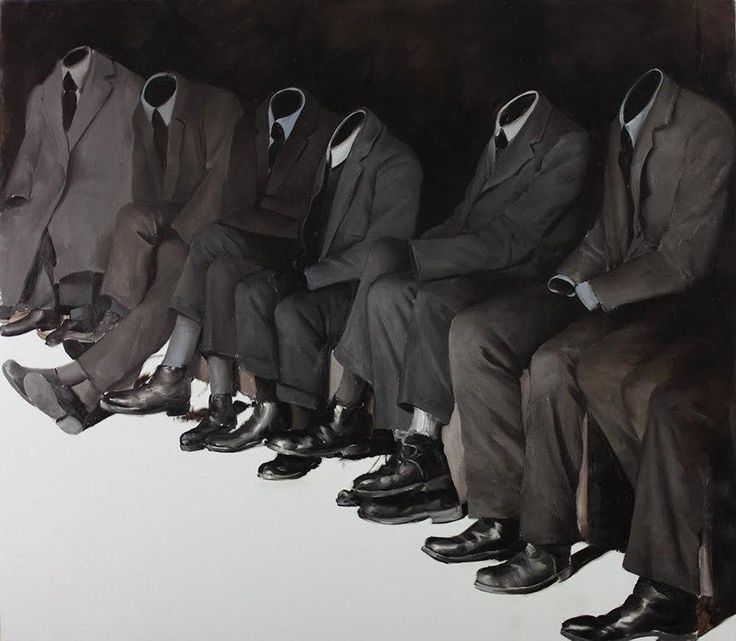
Living in The Second Thought: Notes On OCD & the Search for Certainty
There are minds that walk through the world with a kind of untroubled acceptance, registering events as they occur and allowing them to remain uncomplicated in every day life.
And then there are minds like mine that hesitate, return, and reevaluate every minor action, decision, and thought.
These minds live not in the first perception of reality, but in the second. Their consciousness is shaped by doubt, by the instinct to reconsider, by the suspicion that life is always out to get them if the ritual is missed or or forgotten.
This is not simply overthinking. It is a form of second consciousness; a parallel awareness that shadows the first.
Philosophers have long argued that consciousness is not a single act but a layering of perceptions. You have the world as it appears and the world as the brain chooses to interpret it.
William James called this the “stream” of thought. Your thoughts with OCD are constantly moving, constantly shifting.
But obsessive thought does not stream. Instead it circles. It returns to its origin point as if an infinite leash were attached to the mind. No matter how far you run, no matter how many times you count five steps backward through a doorway or blink three times before touching the towel, nothing cuts that leash.
An obsessive thought is a circle because it tests its own weaknesses repeatedly within a confined limit. It is not satisfied with the surface of a moment. It wants the hidden layer and it wants it so badly that it imagines it when it does not exist.
Living with OCD is living inside this recursive logic: nothing is to be trusted as it is. Not because the mind distrusts the world, but because it mistrusts its own interpretation of it.
This vigilance, though often pathologized, is not without its own intelligence. Doubt has a long philosophical pedigree.
Kierkegaard described anxiety as the “dizziness of possibility,” the mind confronting what could exist rather than what does. In that sense, obsessive thought is not a malfunction but an amplification of a universal human condition.
This condition can be defined as the struggle to rest in a single version of reality. Where others see an event, the vigilant mind sees a cluster of interpretations, each competing for recognition and begging to be in the spotlight.
Certainty becomes less a fact and more of a hope rehearsed through rituals.
And if the interior world of the obsessive mind is full of these competing possibilities, the exterior offers little relief to ease it.
Modern life is saturated with information. We are crowded with alerts, messages, global tragedies, curated lifestyles, and infinite comparisons. The psyche is asked to remain alert, flexible, self monitoring, and endlessly updated. A culture that demands optimization inevitably shapes minds that do not know how to rest.
In this context, OCD becomes not only a clinical condition, but a lens for understanding the psychological structure of our time. The compulsive return to a thought echoes the compulsive return to information. The need to self monitor mirrors a world that monitors everything.
Foucault described modern society as one of internalized surveillance. Obsessive thinking is its most intimate expression.
Yet the obsessive mind has its own strange beauty. A moment is not just a moment; it is textured, layered, capable of shifting color under attention. Even certainty, if and when it arrives, feels like a glass in shaky hands. Something you have to manage rather than just to hold.
To live with a mind that tries to protect itself through the second thought is to live with the awareness that perception is unstable and that understanding is a process, not a destination. It is not an easy way to inhabit the world, but it is deeply human.
The second thought never raises its voice. It prefers professionalism. “Just review that one more time,” it whispers. “Just replay the conversation. Make sure you didn’t accidentally commit a catastrophic moral failure while paying for the groceries.”
As someone with OCD, most of my rumination is invisible. I eat dinner, answer emails, laugh at jokes. No one sees the cognitive archaeology happening inside me. Nobody feels the obsessive reconstruction of memories to ensure I didn’t commit some sinister or humiliating act. Researches call this memory distrust syndrome, where the brain refuses to believe its own records.
This distrust extends into love too. Into intimacy. Into the most ordinary conversations. I replay someone’s tone, my tone, the spacing between our words. Did i sound cold? Too sensitive? Did i accidentally injure someone emotionally without realizing?
It is exhausting to be both participant and analyst in your own life.
The mind cannot sustain this vigilance indefinitelty. Neuroscientists point out that the anterior cingulate cortex, a part of the brain responsible for detecting errors, fires excessively in OCD, even when nothing is wrong (Menzies et al., 2008).
It is the neurological equivalent of a smoke alarm going off in an empty room, insisting that something must be burning.
This is why reassurance does not work. Not because reassurance is flawed, but because the alarm does not distinguish between fire and the possibility of fire.
Kafka understood this well. In The Trial, the protagonist is accused without ever learning the charge. He is trapped in a bureaucracy of meaning, endlessly supplying explanations for crimes that never occurs. OCD feels like that: paperwork proliferating in the absence of wrongdoing.
And the more carefully you examine your intentions, the less familiar they become.
Love becomes one of the first casualties of this scrutiny. Love requires a softness of vision; a willingness to let moments remain imperfect. But the obsessive mind tries to protect the people it loves by anticipating every possible harm. The intention is care, but the result is exhaustion.
Intimacy requires the courage to be known imperfectly. But OCD demands proof that the self one offers is morally safe. Memory, psychologists remind us, is reconstructive rather than archival. But to someone with OCD, reconstruction feels like contamination. If the memory is not crisp, the mind suspects disaster.
And so we return. Again and again. The same scenes, The same expressions. Meaning generated through fear becomes distortion of normal life. It becomes a hall of mirrors, each reflection more exaggerated than the last.
But doubt is not always the villain. Doubt is also imagination. It is an unwillingness to treat the world as a finished project. OCD feels the world intensely because it cannot accept its surfaces at face value.
Still, there is a cost to living at this depth. Certainty becomes a luxury.
Psychologists emphasize the necessity of uncertainty in treating OCD. Lean into doubt, they say. Let the unanswered stay unanswered. It feels, at first, like letting go of the steering wheel on a highway.But eventually the truth becomes clear: certainty is not required for safety. In fact, it is the pursuit of certainty that keeps danger alive.
Camus wrote that humans spend their lives seeking clarity in a universe that offers none. The nobility lies not in achieving clarity but in continuing the search.
And so I practice a different discipline. I allow doubt to exist without assigning it significance. Some days, this feels like asking the sky not to rain. Other days, it feels like discovering the storm is smaller than I expected.
The goal is not to silence the second thought but to stop obeying it. To let it be a shadow rather than a second self.
Joan Didion famously said we all tell ourselves stories in order to live; she did not mention that some of us tell ourselves too many stories, until the original event dissolves beneath all the imagined variations. The task is not to eliminate narratives but to choose which ones deserve attention.
One of the most painful misinterpretations of the stories OCD tells us, both culturally and internally, is the belief that intrusive thoughts reveal something about one’s morality. They don’t. The DSM-5 is explicit: intrusive thoughts are unwanted and inconsistent with one’s values (American Psychiatric Association, 2013).
Women, in particular, are often told their thoughts reflect spiritual impurity, moral failure, or emotional instability. Pop culture has not helped either. Female characters with OCD are flattened into quirks, like Monica Geller’s cleaning habits passed off as comedic, while their deeper moral fear goes unexamined.
Actual OCD in women tends to center around harm, contamination, morality, and sexuality, all domains where women are already socially policed.
This misinterpretation is not accidental; it is gendered.
Male depictions of OCD, such as Howard Hughes in The Aviator, the protagonists of detective shows, tortured geniuses, are framed as brilliance with a cost. Meanwhile, female depictions are framed as endearing neuroses or controlling tendencies.
Rarely does media show the forensic emotional labor women with OCD perform: the moral self policing and the exhaustion from feeling hyper responsible.
Spiritual culture, like manifestation, affirmations, “high vibrational thinking”, is rarely written with OCD in mind. For many, these ideas are empowering. For someone with OCD, they are landmines. If thoughts shape reality, then every intrusive image becomes a curse, every fear becomes a prophecy.
But intrusive thoughts are noise, not intention. They carry no metaphysical authority. Research on thought action fusion (Rachman & Shafran, 1993) shows that people with OCD overestimate the significance of thoughts. Not because the thoughts are dangerous, but because the brain misattributes meaning to them.
A thought cannot manifest into the world, it can only manifest fear.
Signs You May Have Undiagnosed OCD
Clinicians increasingly note that OCD, especially in women, is underdiagnosed because it hides well. It blends into conscientiousness, anxiety, people pleasing, and perfectionism. Signs include:
- Replaying conversations to look for wrongdoing
- Extreme guilt over hypothetical harm
- Avoiding situations not out of fear of danger but out of moral error
- Excessive reassurance seeking
- Feeling responsible for preventing catastrophic outcomes
- Secret rituals performed mentally, not physically
- Difficulty trusting memory or intention
None of these traits make a person dangerous. They make a person exhausted.
Trying to function with OCD is like trying to write a novel while the margins fill with footnotes you didn’t authorize. You’re drafting one life, and the second thought is drafting an alternate one in real time. But the solution is not to erase the second thought, only to demote it. To recognize that it narrates possibilities, not truths.
I am learning to let some questions remains open. To let some memories remain unedited. To let the world be incomplete without assuming it is unsafe.
And maybe that is its own philosophy: a willingness to trust the imperfect and to let the world be more than the fear that interprets it.
I am learning slowly and stubbornly, to live not without the second thought, but alongside it.
Sources & Further Reading
American Psychiatric Association. Diagnostic and Statistical Manual of Mental Disorders (DSM-5). 2013.
https://doi.org/10.1176/appi.books.9780890425596
Menzies, L., et al. “Integrating Evidence from Neuroimaging and Neuropsychological Studies of Obsessive–Compulsive Disorder: The Orbitofronto–Striatal Model Revisited.” Neuroscience & Biobehavioral Reviews, vol. 32, no. 3, 2008, pp. 525–549.
https://doi.org/10.1016/j.neubiorev.2007.09.005
Rachman, S., & Shafran, R. “Cognitive Theory of Obsessive-Compulsive Disorder.” Behaviour Research and Therapy, vol. 36, no. 9, 1998, pp. 667–685.
https://doi.org/10.1016/S0005-7967(98)00063-9
van den Heuvel, O. A., et al. “Frontal–Striatal Dysfunction During Planning in Obsessive–Compulsive Disorder.” Archives of General Psychiatry, vol. 62, no. 3, 2005, pp. 301–309.
https://jamanetwork.com/journals/jamapsychiatry/fullarticle/208327
Gillan, C. M., et al. “Disruption in the Balance Between Goal-Directed Behavior and Habit Learning in Obsessive-Compulsive Disorder.” American Journal of Psychiatry, 2011.
https://doi.org/10.1176/appi.ajp.2011.10071062
Salkovskis, P. M. “Obsessional–Compulsive Problems: A Cognitive–Behavioural Analysis.” Behaviour Research and Therapy, vol. 23, no. 5, 1985, pp. 571–583.
https://doi.org/10.1016/0005-7967(85)90105-6Salkovskis, P. M. “Thought-Action Fusion: A Possible Role in the Pathogenesis of Obsessional Problems.” Behaviour Research and Therapy, vol. 33, no. 1, 1995.
https://doi.org/10.1016/0005-7967(94)00040-S
About the Author
Ola Anwer is a writer whose work explores psychology, consciousness, and the cultural narratives surrounding mental health. Drawing from her own experience with OCD, she examines how doubt, gender, and perception intersect to shape interior life. Her essays investigate the patterns of thought that shape perception, intimacy, and the stories we construct around uncertainty.