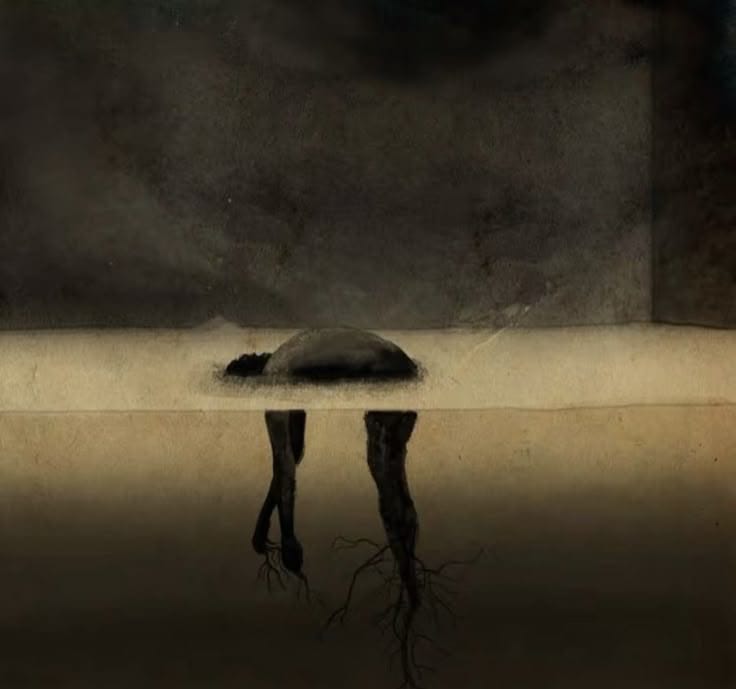
Splitting at the Seams
Up to 150 species go extinct daily. The acquisitions of businesses, housing units, and family heirlooms on Facebook marketplace transpire every minute. Class-action lawsuits are decided with impunity, giving life sentences, severe fines, or nothing at all. Flowers bloom. A girl laughs. Scientific discoveries regarding free, unlimited energy, rising sea levels and long-term psychological effects of electronics are unveiled, while 99% of us barely bat an eye.
None of these are the slightest bit interesting to the average person if there is no story attached to them. We are each possessed by stories of our own – working eighteen-hour days in a factory, baking cookies for a bakesale, touring the latest album, idly masturbating on our California-King before ordering Ubereats – that our attention is barely captured by the boldest of headlines.
News outlets attempt to shake us from this with tragedy – violent crime, political scandal, extreme weather – only succeeding in desensitizing us further. The student, endlessly studying for his bar exam, has no time to research the geopolitical reasons for the famine in Sudan. The hospital secretary, processing an ever-growing waitlist of ill people, cannot spare a second for a polar bear who drowned on a prematurely melting glacier. The daycare worker, hearing first words every day, has little to say about the economic implications of the AI bubble.
Yet, we each seek an escape, something deeper than the story of our lives: something interwoven with the fabric of civilization, with Earth in her natural beauty, with the cosmos itself. Whenever we have a spare moment, we subscribe to Netflix, read literature, attend concerts, listen to podcasts at 2x speed, scroll, searching for something to stop us in our tracks and ask, “and then what happened? ”
It’s easy for this thirst to be quenched by a regurgitated narrative. Farmboy fights technovillain. Co-workers fall in love. A band of misfits team up to save the popular kids from evil. Yet the hunger is seldom satisfied by these stories. Perhaps that is why those tasked with storytelling reuse sensational commentary, recycling scripts regarding war, romance, and political announcements with a mock critical flavor.
The true storyteller identifies the cosmic in the microcosm. They showcase the karma unfolding in the bong-ridden brick apartment of an unemployed boyfriend and a PMS-ing corporate girlfriend. They invoke as many mundane, incidental details as possible, while pointing to something deeper than any one of us: something grand, interwoven with the fabric of civilization, with Earth in all her natural beauty, with the cosmos itself.
This is the storyteller’s highest honor and greatest responsibility: to reveal the experience Western hippies call ego death, what monks call Nirvana. The feeling of recognition that the main character is living a life just as real as mine, and inversely, that my life is just as real as theirs. The person listening, watching, on the edge of their seat, is how I remember that I already exist within an immense narrative, not requiring embellishment.
Why am I telling you this? Because you are a storyteller.
All that you know and think, the mundane aspects of your daily life, are shards of a story that is only yours. Now more than ever, in a world of generated slop from machines that have no concept of experience – laughing while biking across a bridge in Japan, saving an earthworm while gardening, feeling the heartbreak of knowing the person you once loved is now kissing and doing drugs with someone else – it is important to share.
In a world perpetually interrupted by blue light, pharmaceuticals, lease renewals, we must share our stories in a way that tethers us together. Despite the normalcy of subscription-based art, where every story we pay for is not ours, you, the storyteller, can remind someone that which is impossible to deny: they own their lives.
Despite culture blasting us with pornography, materialism, political horror, the illusory dream of a white picket fence where everything is safe and nothing changes, we each have a golden thread that can never be bleached, weaving through the rollercoaster ride of our lives. Despite stories being reduced to a digital scroll, we must task ourselves with sharing our story, until our one true subscription ends.
We’ve all heard the story of the one act of kindness that shifts a person away from suicide. We all know how a positive comment in a music studio can lead to the release of a hit single, breeding a new genre of hyper-pop, a moment of transcendental self-acceptance for an angsty teen trapped in suburbia. You know the downhill bike ride, orange streetlights, wondering how long before you die, whether there will ever be a judge of your life, and whether, after your striving to be good, you would even want there to be. You want someone to see all the times you tried, to witness the haphazard uphill bike ride becoming the very motivation to keep going, because you are here for all of it: the coyote ambling through the park, the shy gaze upward at a cosmic sky hidden by light pollution, the love in the invisible wind.
Your story is not something that has to have a mission. It needs only to be recognized, in the earth, the buildings, the sounds, the way the ground feels beneath you, the breath, the distinction between you and I, and put into words.
Can you tell me your story?
About the Author
David K.S Upadhya is an author from Toronto, Canada currently working on his debut novel. He enjoys long promenades through the recesses of society’s subconscious, freshly fallen snow, wormholes and dark chocolate. He goes by Panpsyche, and you can find him as @panpsyche on Instagram.