“A Free Woman, A New Creature”: Yeats and the New Woman as Muse by Abbie Mourey
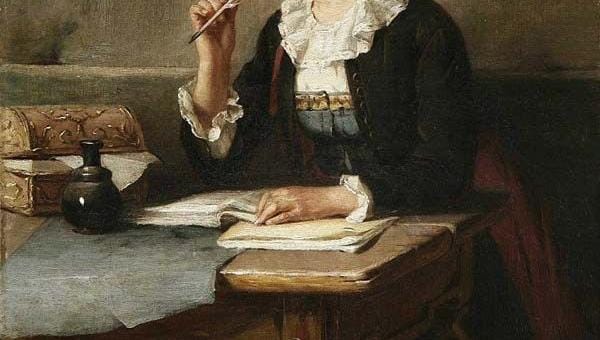
In the third chapter of her book, The Reading Figure in Irish Art in the Long Nineteenth Century, Tricia Cusack records a pivotal scene from a short story by Sarah Grand (73–74). Grand, a prominent, late-nineteenth-century women’s rights activist in Ireland, captures one possible reaction to “the New Woman,” in her story, “The Undefinable” (73). An artist and the woman posing for him discuss the man’s work, and as they speak, the man states, “I recognized her now—a free woman, a new creature, a source of inspiration the like of which no man hitherto has ever imagined in art or literature” (73–74). During the mid-nineteenth and early twentieth centuries, the term— “the New Woman”—came to describe various kinds of women, many of whom refused to conform to the “patriarchal dominance” of their Western cultures (71).
William Butler Yeats maintained a complicated relationship with these New Women. Cusack cites Yeats’s own sisters, Lily and Lolly Yeats, as examples of New Women, yet Yeats’s feelings about women in the arts do not fit easily into the categories of approval or disapproval (67–69). Yeats also maintained various relationships—both romantic and professional—with other women who could also be described as New Women, such as Maude Gonne and Dorothy Wellesley. Yeats’s intricate relationships with these women are revealed through his poetry and reflect the complex and evolving feelings of many Westerners during the late nineteenth and early twentieth centuries.
The phenomenon of the New Woman arose in the mid-1800s. At the same time, many male literary societies and clubs were forming. In her article, “A Club of Their Own: The ‘Literary Ladies,’ New Women Writers, and Fin-De-Siècle Authorship,” Linda Hughes details how female writers at this time also began their own associations and how many male authors reacted negatively to women gathering independently as intellectuals (241–42). These women were satirized in newspapers and condemned as sexually immoral for gathering as “unaccompanied women in public spaces” (242). The negative reactions to the first “Literary Ladies” dinner were rooted in ideas of how women should be educated and the role of women in art (239–44).
William Butler Yeats voices the feelings of many in the West when he writes the following in a letter to Katherine Tynan about women’s education: “What poor delusiveness is all this ‘higher education for women’ . . . They come out with no repose, no peacefulness, and their minds no longer quiet gardens full of secluded paths and umbrage circled nooks, but loud as chattering marketplaces” (Cusack 64). Similarly, as Hughes notes, a great critique of the Literary Ladies dinner parties is “that the Muses, being women, [yield] only to the embraces of men” (244). Though Yeats takes a different view of the female writer’s relationship to the muses, he does hold the same underlying assumptions that lead to this view of women as muses, rather than women taking inspiration from the Muses.
Though many expressed outrage at the gathering of New Women in the Literary Ladies dinner club, contradicting opinions regarding the issue of “women of letters” were rampant. Certain critics of female literary groups argued that the women’s association violated the very equality these women claimed to desire (245). One newspaper reports, “We shall be very glad to see the literary ladies side by side with the literary men at our own dinner next month” (qtd. in Hughes 245). While this statement ignored the fact that many of the male literary clubs actively barred women from joining, it captures the strange position many New Women found themselves in within their societies (245–51). Attitudes toward the New Women—many of whom were artists, writers, and political activists—continued to change as the nineteenth century drew closer to the twentieth century (250–54). Hughes asserts, as the Literary Ladies continued to meet, their meetings garnered kinder press coverage—frequently from female journalists—and less cultural alarm (252). The group’s first dinner had a guest list of about thirty-five; their sixth meeting had sixty ladies at the table (247, 252). After the onset of World War I, the Literary Ladies no longer met and after the war there was “no pressing need” for the women to gather (253). The women could now write with greater freedom than ever before.
Oddly enough, Yeats in several letters later in his life described an appreciation for how women interact with art, even going so far as to desire to experience aesthetic appreciation as a woman would. In his article, “All the Wild Witches: The Women in Yeats’s Poems,” author Samuel Hynes records two letters Yeats sent to female friends, “In a letter to Ethel Mannin in 1935 he wrote: ‘You are doubly a woman, first because of yourself and secondly because of the muses, whereas I am but once a woman” (581). In the second letter for Dorothy Wellesley in 1936, Yeats wrote, “It seems that I can make a woman express herself as never before. I have looked out of her eyes. I have shared her desire” (581). These words are quite different from those Yeats sent to Tynan in 1889 (120–124). Yeats maintained a complicated relationship with the feminine throughout his life, and this complexity expressed itself in his poetry.
In the poem, “Adam’s Curse,” Yeats writes from both the male and female perspectives. As the male narrator, Yeats laments the pains of the poet, the difficulties poetry demands, and claims the poet’s work is more difficult than that “of bankers, schoolmasters, and clergymen” (ll. 1–13). As the male narrator sits with two women—Maude Gonne and her sister— “that beautiful mild woman” responds to the man’s claims about the difficulties of writing poetry (Pethica 32n1; l. 16). This female speaker states, “‘To be born woman is to know— / Although they do not talk of it at school— / That we must labour to be beautiful” (ll. 19–21). The male speaker takes this opportunity to transition the conversation to the topic of love, only vaguely addressing the female speaker’s point, “‘It’s certain there is no fine thing / Since Adam’s fall but needs much labouring. / There have been lovers who thought love should be / So much compounded of high courtesy” (ll. 22–25). While the male speaker mentions the curse put on womanhood during the Fall—pain in childbirth—he makes this pain equal to all agony necessary to make “fine things” (l. 22). The male voice also never truly responds to the female speaker’s comments on beauty, or the pain women experience in attaining such beauty. How literally one takes the claims of Yeats’s poetic persona is subjective. While this element of the poem remains an open-ended question, it is clear the male and female narrative voices are distinctive and do not “become one.” The male narrative voice longs for union with the woman in the poem who does not speak: Maude Gonne. Gonne is present but remains silent throughout. This silence reflects an important element of Yeats’s conception of male and female personas, and by extension, male and female artists.
Hynes characterizes Yeats’s attitude to women as typical of many nineteenth-century male artists. Within his poetry, women or any entity that the poet characterizes as feminine, often act as forces of “female energy” (574). As Hynes explains, Yeats sees men and woman as inhabiting two realms: women become subsumed in “nature” and men in “history” (573–75). Yeats sets forth this ideal in “Adam’s Curse.” Men bear the brunt of creating great works of poetry, and women must birth and nurture offspring. However, while this may be the ideal Yeats sets forth in various poems, Hynes claims that many of the women in Yeats’s poems, particularly those of the “middle period” of his poetry, do not adhere to this vision of women in nature (574). In several of his more political works, Yeats has women serve in historical roles (574). In his play Cathleen ni Hoolihan, the old woman who interrupts the wedding preparations of an Irish family, is Ireland personified (140). While it was common practice to describe a nation using feminine pronouns or portray a country as a woman in painting and sculpture, this is not merely a poetic convention in these works; clearly, women occupy and embody a historical role in various places in Yeats’s art. Hynes also points out that Yeats “liked fine women, even crazy ones,” including women who took up various political causes (574).
For Yeats, these dichotomies are also essentially connected to the need for a muse. In his letter to Ethel Mannin, Yeats desires and even envies Mannin’s ability to be a muse and share in their gender (581). While Yeats endeavors at various points in his work to unite the masculine and the feminine, this unity remains temporary (576, 582). When the muse can no longer serve a sexual role, the union crumbles (576). The power of the muse, then, becomes “retrospective”; and while this retrospection is powerful, it cannot last forever (576). The poet is left searching for a muse to fulfill a role—a woman in nature—he is not truly attracted to, while the woman in history becomes his true desire.
Yeats’s multifaceted views on women in the arts and as muses are in many ways reflective of how numerous men in the West also felt during this time. At the same time women became more involved in the arts, they also became more engaged in various political movements. Women’s roles as muses also evolved as it became more acceptable for women to become artists and activists. Yeats’s poetry and plays reflect the conflicting ideals for women during the late 1800s and early 1900s. His later letters reveal a desire to experience love, poetry, and life as a unity between the masculine and the feminine.
Works Cited
Cusack, Tricia. “The Shaping of the New Woman in Ireland.” The Reading Figure in Irish Art in the Long Nineteenth Century, Anthem Press, 2022, 59–77. https://doi.org/10.2307/j.ctv2902b23.8.
Hughes, Linda. “A Club of Their Own: The ‘Literary Ladies,’ New Writers, and Fin-de-Siècle Authorship,” Victorian Literature and Culture, vol. 35, no. 1, 2007, 233–260. https://www.jstor.org/stable/40347133.
Hynes, Samuel. “All the Wild Witches: The Women in Yeats’ss Poems,” The Sewanee Review, vol. 85, no. 4, 1977, 565–582. https://www.jstor.org/stable/27543298.
Yeats, William Butler. “Adam’s Curse.” Yeats’ss Poetry, Drama, and Prose, W. W. Norton & Company, 2000, 32.
———. Cathleen ni Houlihan. Yeats’ss Poetry, Drama, and Prose, W. W. Norton & Company, 2000, 133–140.
About the Author
Abbie Mourey was born and raised in New York’s Finger Lakes region. Her work has been published in Westmarch: A Literary Jouranl, Cicada: Literary Magazine, and The Hyacinth Review. She is a graduate student at the Catholic University of America.