Capturing Stream of Consciousness through Sound and Supporting Characters
The term stream of consciousness can be defined as a narrative fiction technique that captures the awareness and consciousness of an individual character through a “flow of myriad impressions—visual, auditory, physical, associative, and subliminal.” This technique was coined by psychologist William James in 1890 and soon gave birth to the psychological novel that many recognize today. Stream of consciousness writing has allowed writers such as Virginia Woolf and James Joyce to abandon the conventional grammar and narrative form, producing works that are rich, yet sometimes deliberately fragmentary. This form of fiction is especially prevalent in Clarice Lispector’s novels and works of literature, such as Un apprentissage, ou, Le livre des plaisirs (An Apprenticeship or The Book of Pleasures). In 2022, Marcela Lordy directed a “free adaptation” of Lispector’s novel titled The Book of Pleasures or The Book of Delights, depending on the title’s translation. On a personal note, I am very drawn to stream of consciousness writing and Lispector are one of my favorite authors. Being familiar with her literary style and form, I found it hard to believe that it was even possible for an adaptation to be made based on her works because much of her writing is anything but tangible, and both Lóri and the reader seem to exist in the ether of her mind. How could tedious and exhaustive thought be conveyed into an audio-visual medium? By replacing Lispector’s stream of consciousness with an auditory experience that balances silence as ambient sound, and dialogue, while amplifying the roles of supporting characters, Lordy’s The Book of Delights reframes Lóri’s internal existential journey as a sensory process dependent on interaction with the external world, and in doing so, detracts from the novel’s emphasis on individualistic existentialism.
Lispector, born in Ukraine in 1920, immigrated to Brazil at age five. Eventually, as a young woman, she became a journalist and her debut novel, Perto do coração selvagem (Near to the Wild Heart) was published in 1944, when she was just 24 years old. Throughout her adult life, Lispector published multiple books that focused on the human condition and her characters’ place in the grand scheme of life. My personal experience with her novels and research has revealed that her works consistently employ stream of consciousness as her primary mode of narration. In her three novels that I have analyzed more deeply thus far, Lispector achieves this style of writing through fragmented syntax, experimental punctuation, repetitive language, and tedious focus on actions or mere notions. In Lispector’s 1969 novel An Apprenticeship or The Book of Pleasures, the main protagonist, Lóri, an elementary school teacher struggling with the pain and the pleasure of her own existence, finds herself in a complex romance with a philosophy professor, Ulisses. The book is 149 pages filled with a conglomeration of inner monologues mixed with some dialogue that depicts Lóri’s journey from semi-suicidal misery to a new peace emboldened by her deep love with Ulisses.
According to the Merriam-Webster Dictionary existentialism is a philosophical ideology that focuses on and questions the individual existence in relation to the universe. Almost every page of the translated copy of Lispector’s novel reveals aspects of Lóri’s interior dialogue, tracing her transformation into a “human being” that is truly ready for love and life. The primary way that Lordy was able to convey such intense and continual thought was through the use of silence, or what we may perceive as silence on the surface. For Lóri, “Silence is the profound secret night of the world,” representative of both chosen solitude and self-enforced isolation (Lispector 25). On page 24, it is explained that she often cannot condense the surge of thought and emotion into conversation which forces her to isolate because “Whatever happened in Lóri’s thought in that dawn was as inexpressible and incommunicable as the voice of a hushed human being,” until Ulisses prompts her to try writing out her thoughts (Lispector 24). In the novel, from pages 24 to 28 and beyond, there are a series of thought fragments that primarily focus on the role of silence in not only her life specifically, but life as a general concept. This innately interior structure is what Lordy has to translate into a visual medium that doesn’t depend entirely on language. The film’s reimagining of thought as sound and silence expresses what Lispector keeps internal, signaling a divergence from the solitary contemplation that Lispector creates in her novel.
As seen in Figure 1, the film begins with a Lispector quote in Portuguese that states “The heart must present itself alone before Nothingness, and alone it must beat loud in the darkness.” The quote is then followed by an opening credits scene presenting a kaleidoscope of moving limbs and faces participating in sexual acts over a track of ambient music. Eventually the sound of childhood chatter and the ringing of a school bell act as a tool to rouse the audience out of an almost induced hypnotic state, preparing them for the story that is about to unfold. We are then we are transported to the classroom where Lóri teaches her children. She sits at her desk complacently as the kids zip out of the room. The camera shot begins to zoom in on her face and as it does her mask begins to falter. A dread seems to take root as her gaze flits about the room while the subtle roar of white noise builds over the school sounds. This early use of ambient sound and delayed dialogue exemplifies Lordy’s substitution of internal thought for sensory experience as she transforms Lispector’s mental interiority into atmospheric scenes.

Lordy’s auditory technique is usually paired with dynamic visual shots and effects that convey perception that is not entirely lucid, placing both Lóri and the viewer in a dream-like state as seen in Figure 2, where Lóri ruminates on her upcoming date with Ulisses, smoking a cigarette overlooking her view of the beach. A montage ensues, combining images of Lóri, the cigarette, flames, and the landscape itself. This is paired with the ambient noises of breathing, cigarette drags, and waves before barely perceivable music rises in the background. Her call to Ulisses cancelling the date is then played over the montage. Though effective and aesthetically satisfying, this scene in no way captures the sheer volume of complex thought flooding Lóri’s mind within Lispector’s novel. During the novel’s corresponding scene, Lóri’s thoughts range from the lack of summer rain, her tendency to reach “the point of hating Ulisses, even while still getting him to want her,” and her pleads to God in her anguish of the “awareness of her permanent human fall,” (Lispector 16)

In chapter XII of John Huston’s Filmmaking by Lesley Brill, Brill analyzes Huston’s film adaptation based on The Dead, a short story written by James Joyce. In a similar case to Lordy, Huston was tasked with transforming literature, though not technically considered a stream of consciousness, but that possessed a certain musical quality into film. The short story takes place over the course of a dinner party where there are song, food, dance, and drink, all centered around the main character, Gabriel. In the case of The Dead, Brill asserts that contentions with the passage of time and death are conveyed through the auditory landscape, which, in this film, is primarily made up of music. He states that “Like dance, music has double associations with life and mortality” (Brill 211). The beautiful rendition of “The Lass of Aughrim” rouses a deep reminiscing within Gabriele’s wife Gretta, who ponders the death of a long, lost love, connecting music with memory and thought, and as the song is actively being sung by D’Arcy the audience can sense Gretta having been moved to another space and time that is separate from the staircase that she currently haunts. The Dead’s idea of music being a representative of the ponderance of life and death is similar to this opening scene where we see Lóri’s face for the first time as the soundscape helps explicate the emotions rippling on the interior.
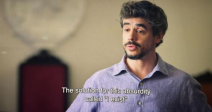
The use of silence in this case is actually the closest thing we can get to the human perception of silence meaning the ambient noises of everyday life such as breathing, moving, a fan blowing, which make up a majority of the movie’s audio. The first discernable word is not uttered until 8:19 minutes into the film, where Lóri visits Ulisses’s lecture, as seen in Figure 3. Notably, the first words of this film adapted from a novel that focuses primarily on stream of consciousness, are not even her own. This decision externalizes the statement that a novel is able to explicitly assert in its prose: in the beginning of this journey, Lóri doesn’t have her true sense of self yet, and she placed her hope in Ulisses to find herself for her, which can be exemplified in the quote “Lóri was afraid of falling into the abyss and was holding one of Ulisses’s hands while Ulisses other hand was pushing her into the abyss,” where he is pushing for her to discover herself and desire to “become a human being” (Lispector 21). For a time, his words become her own and her own thoughts are mere responses to what he says or what she thinks he would say. In the closing of Ulisses’s lecture, many of his teachings introduce the thoughts on the “absurdity called ‘I exist’” Lóri tediously grapples with throughout the novel.
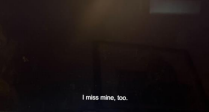
In the film, the roles of certain character’s, particularly family members, are amplified in a way that allows them to be a vehicle to explain Lóri’s past and the way said past has molded her into the floundering woman that she is at the time the movie takes place. In both the book and the film, it is revealed that Lóri’s mother passed away when she was a young girl. During her mother’s successful career, the family, consisting of husband, wife, one daughter and three brothers, traveled the world. In the novel, the actual death of her mother doesn’t have as big of an effect on Lóri emotionally, but more as a tool to discuss her travels and thoughts on existence with Ulisses. On page 34, Lóri briefly recounts that she had explained the period of her life when her mother died and the family fortune was reduced greatly but she spent more time explaining an experience she had in Paris during their travels. She attempts to explain how Paris gave her “the oddest pain – that of her real perdition” in which perdition is “the unreality that would let her sense her true condition” (Lispector 35). In the film, on the other hand, Lóri’s mother plays a very large role in displaying this struggle to find the will to exist and dare I say rivaling Ulisses’s place as the most prolific character next to Lóri herself. In the film, Lóri helps out a working mother of one of her students named Otto by watching him for a night. By introducing the invented character Otto, Lordy is able to produce a scene where the eight-year-old and his teacher quietly bond over a shared sense of maternal absence as Otto tries to fall asleep. He asks if Lóri will stay with him until he has drifted and, in the darkness, and silence of night he says, “I miss my mommy,” and after a moment of quiet she responds, “I miss mine, too,” but only the audience knows that her mother is dead and his mother is merely on a work trip, as seen in Figure 4.
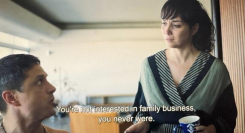
Similarly, Lordy makes the decision to bring one of her brothers, Davi, into the narrative when he comes to visit her in Campos, as seen in Figure 5. The insertion of his character into the narrative allows Lordy to give further context to the way Lóri operates in the world and in her relationships. We, as the audience, learn that she avoids emotional intimacy, and not just in her increasingly romantic relationship with Ulisses, but in her relationship with her family, especially after the passing of her mother. We learn that she has up and left her father and her siblings when her brother responds to Lóri’s protests when she discovers that they decided to sell her mother’s house. Through this interaction, we see her pain and frustration, and it is one of the few times we see her mask of detachment slip. By revealing Lóri’s relationships beyond Ulisses, Lordy further externalizes the novel’s limited introspective solitude and almost insinuates that human connection may be her salvation rather than the interior journey she embarks on within the novel.
Through Lordy’s use of silence, sound, and additional dialogue present in expanded relationships, she is able transform the language of Lóri’s interior voice into a sensory cinematic experience that manages to capture the contemplative nature of Lispector’s writing. The film highlights Lóri’s past, present, and metamorphosis through human connection over isolation and introspection, which detracts from Lispector’s overall individualistic existentialism. That being said, Lordy was as true and faithful to the text as one can be as she was still able to capture glimpses of interiority through atmosphere and perception, showing an external expression of deep introspection through the use of audio.
Works Cited
Lispector, Clarice, et al. An Apprenticeship or the Book of Pleasures. New Directions Publishing Corporation, 2022.
Lordy, Marcela, director. The Book of Delights, IMDB,
www.imdb.com/title/tt13350988/?ref_=ttpl_ov_bk. Accessed 22 Oct. 2025.
(Secondary Source: Brill)
Brill, Lesley. “Chapter XII: The Dead.” John Huston’s Filmmaking , Cambridge University Press, 2006, pp. 207–226.
“Clarice Lispector.” Encyclopædia Britannica, Encyclopædia Britannica, Inc., www.britannica.com/biography/Clarice-Lispector. Accessed 22 Oct. 2025.
“Stream of Consciousness.” Encyclopædia Britannica, Encyclopædia Britannica, Inc., www.britannica.com/art/stream-of-consciousness. Accessed 22 Oct. 2025.
“Marcela Lordy – About.” About – Marcela Lordy, www.marcelalordy.com/ABOUT. Accessed 22 Oct. 2025.
About the Author
Laney Currin is a creative writer interested in strange and speculative fiction that explores on feminism and existentialism. She is currently pursuing an M.A. in English at ASU after graduating from UNC Chapel Hill with a B.A. in both English & Comparative Literature and Media & Journalism, along with a minor in Italian.