Dostoevsky’s Antidote to Pessimism and Religious Doubt in Notes from Underground
The second half of the 19th century found Europe in a precarious position. The Christian faith faced continued assaults from major developing forces. Rapid industrialisation and mass production through machines took away the value previously placed on the unique potential of a human. Imperialism reduced religion to a tool to justify the oppression of the “uncivilised” Other. Charles Darwin’s On the Origin of Species rejected the idea that humankind is the descendant of Adam and Eve and demonstrated how humans have evolved from apes. Auguste Comte and Ludwig Feuerbach’s theories, along with the rise of political ideologies like Marxism, questioned the value of God and Religion. In his Studies in Pessimism, Arthur Schopenhauer directly denied the existence of an all-loving God. The proverbial last nail was planted in the coffin by philosopher Friedrich Nietzsche when he announced God’s death.
It is important to understand, however, that the void left behind by the waning of Faith was not immediately filled by Reason and Science. The lack of a firm ideal to hold on to resulted in nihilism. Victorian writers like George Gissing and Thomas Hardy explore this hopelessness that seized people in their works. G.K. Chesterton calls the age “an epoch of real pessimism”.
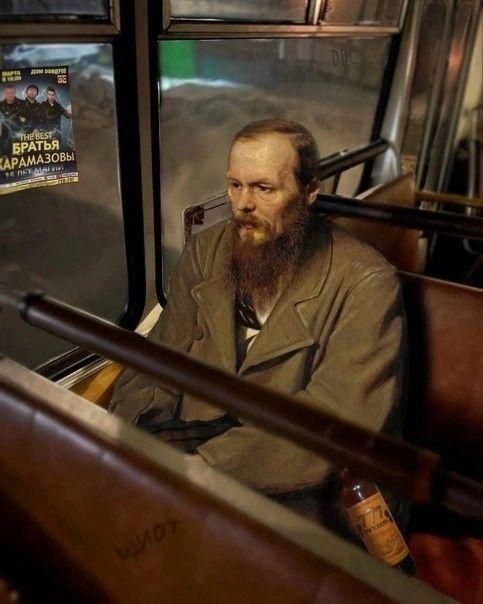
Amid this despairing confusion and ennui, we meet the Underground Man in Fyodor Dostoevsky’s Notes from Underground (1864). Through him, Dostoevsky depicts the alienation of those who could neither be utterly blind to the arguments against God nor could fully embrace the dictates of scientific rationalism. The Underground Man reacts to this dilemma with bitter anger and petty spite, a motif that runs through the entirety of Notes. He rejects, scorns, and criticises everything, even himself and the reader. The novel opens with his blunt confession: “I am a sick man…I am a spiteful man. I am an unattractive man”(3; 1, I), setting the tone for the rest of the work.
Part I of the book sheds light on his life in this dismal, faithless world of the underground. He justifies his inability to make anything of himself by saying, “…a man in the nineteenth century must and morally ought to be pre-eminently a characterless creature”(6; 1, I). His failure to “even become an insect” is assigned to hyper-consciousness, which he names a “disease”. He envies the “direct persons” and “men of action” who readily accept the dictates of Science in the absence of Faith. The limited consciousness they possess prevents them from overthinking. He denounces people who are easily able to embrace the laws of nature, the deductions of natural science, and mathematics. The Underground Man refuses to accept the implications of Darwin’s assertions about evolution and rejects the Scientific Determinism that categorises and defines a human, their desires, actions, nature, and interests with “mathematical exactitude”. He prophesies that if such a formula that can calculate all “desires and caprices” is discovered, then humans will cease to feel desire, robbed of their free will(41; 1, VIII). The Underground Man further argues that humans are bound to go against reason, by contriving chaos and destruction, by going mad or by inflicting suffering on themselves and others simply to escape the calculation and tabulation of their actions by reason and thereby prove to themselves that “men still are men and not the keys of a piano”(47; 1, VIII). Nietzsche too, discusses this eternal conflict between Reason and Desire in the antithetical characters of the “rational man” and the “intuitive man”.
Through these passages of Part I, Dostoevsky attempts to answer one half of the original dilemma that plagues the directionless mind of the late 19th century – whether one should blindly embrace Reason as the new god. But that is not enough. The existential despair remains – the solution to which Dostoevsky attempts to give in Part II of the novel, particularly in the Underground Man’s encounter with the prostitute, Liza.
The Underground Man repeatedly chooses suffering and even finds enjoyment in pain. J.A. Jackson confirms that the Underground Man’s desire to suffer, confess and humiliate himself reveals a critical Dostoevskian insight – “Man is not born for happiness. Man earns his happiness, and always by suffering”. The Underground Man desires to go beyond the tired repetition of spite and despair that he finds himself trapped within. He mentions, “… it is not underground that is better, but something different, quite different, for which I am thirsting, but which I cannot find!”(58; 1, XI).
Michael Katz, through his reading of Dostoevsky’s letter to his brother Mikhail, claims to have deciphered the Underground Man’s cryptic reference to “something different”. (Jackson) Dostoevsky believed that Notes would be able to express the ideological dead-end of the 1860s and exhibit “the need for faith and Christ”. When censors cut these selected areas, Dostoevsky sought to express his ideas differently, in Part II, through Liza. This provides, albeit momentarily, a solution to the underground, a way out of the materialistic nihilism of rational egoists, and a solution to the spiritual decay of the people in the late Victorian era. The antidote to this self-destructive ethos is found in Faith, in offering oneself to the other person altogether, annihilating the demands of the Ego, as Christ himself did for humankind. Even before Sartre, Dostoevsky had defined Hell as the torment of not loving. One cannot survive for long under such conditions. Ernest Becker, in The Denial of Death, observes how the lack of a divine figure results in the superimposition of that divine love on a human subject. The interpersonal thus merges with the religious in the section concerning Liza.
In his moment of absolute vulnerability to Liza, the Underground Man experiences “a hysterical attack” and confesses to her about his suffering and despicable nature. But instead of being repulsed by him, Liza embraces him in an act of unconditional Christ-like love, despite all his insults. The Underground Man sobs in Liza’s arms for fifteen minutes and finds his “something different”. In those few pure moments, Liza offers the underground man a glimpse of divine salvation through human love, something sterile Reason could never provide. After proving through the entirety of Part I that there is more to life than rational egoism, in Part II, Dostoevsky offers an alternative and thus resolves the second half of the original dilemma – how to find redemption through love in an age of doubt.
Works Cited
Becker, Ernest. The Denial of Death. 1973.
Dostoyevsky, Fyodor. Notes from Underground. 1864.
Jackson, J. A. “FREEDOM AND OTHERNESS: THE RELIGIOUS DIMENSION OF DOSTOEVSKY’S ‘NOTES FROM UNDERGROUND.’” Religion & Literature, vol. 43, no. 3, 2011, pp. 179–86. JSTOR, http://www.jstor.org/stable/23347097.
About the Author
Soumyodip lives in Kolkata, India. He has an M.A. in English Literature. He is deeply passionate about exploring Speculative Fiction, often living vicariously through characters in such books. When he is moved, he writes. His work has previously appeared in a poetry anthology from Exceller Books.